Saint MacNissi's Church
Randalstown

CHURCH FEATURES

Church Features
Our church is a sacred place of prayer, worship, and community. There are signs and symbols throughout that reflect the deep spiritual meaning of our Catholic faith.
This guide to the features of our church is intended to help both parishioners and visitors understand the purpose and significance of each space, object, and symbol — from the Main Entrance to the Tabernacle.
.jpg)
01
Main Entrance
The main entrance of our church, consists of double doors leading into the Narthex, the gathering space for the faithful.
These doors are adorned with imagery of flowing water, symbolizing the waters of Baptism — the sacrament by which one enters into the life of the Church.
Liturgically, the main entrance is referred to as the West Door, regardless of its actual geographic orientation. The practice of worshiping towards the East has significant roots in both Jewish and Christian tradition.
For the Jewish people, facing East during prayer originated during the time of exile. As they were separated from Jerusalem, they desired to pray in the direction of the Holy of Holies, the most sacred part of the Temple in Jerusalem.
For Christians, facing East during worship has a deeper theological significance. At the Ascension, Christ was promised to return from that direction at His Second Coming, a belief that continues to shape the orientation of Christian worship.
Historically, priests also faced East during the celebration of the Mass, with their backs to the congregation. This practice remained until the reforms of Vatican II, when the Church introduced a new understanding of liturgical participation, leading to the more familiar practice of the priest facing the people during the celebration of the Eucharist.
02
The Narthex
Locally referred to as "the porch", the Narthex serves as an informal gathering area where parishioners can meet, exchange greetings, view church literature, and contribute to donations. It is also sometimes a space for fellowship, such as enjoying tea or coffee after Mass.
Artistic symbols within the Narthex convey the significance of the Sacrament of Baptism. Streaks of red and blue on the floor represent both water and the Holy Spirit, symbolizing the elements central to this sacrament. Above, a stained-glass window depicts the dove, a symbol of the Holy Spirit, recalling the moment when the Spirit descended upon Jesus at His Baptism in the Jordan River.
Leaving the Narthex through an inner set of doors, adorned with metal plates suggesting waves of water, we cross a threshold into a very different area, the Sacred Space.
.jpg)

03
Baptismal Font
Upon entering the Sacred Space of the church, the first feature we encounter is the Baptismal Font, symbolizing the beginning of Christian life through the Sacrament of Baptism. As we enter and exit the church, we are reminded of our Baptism by making the Sign of the Cross with the Blessed Water.
Crafted from Kilkenny Limestone, the Baptismal Font features a large octagonal bowl, with a canopy above. The canopy is adorned with a beautiful mosaic depicting a star, symbolizing the coming of Christ.
04
Mary, the Mother of Jesus
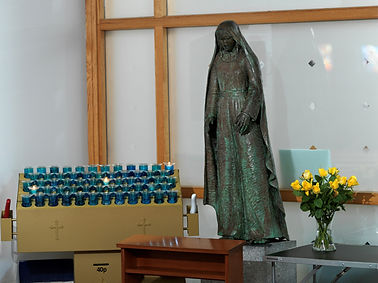
To the right of the Baptismal Font, a statue of a young girl resides, representing Mary, the mother of Jesus. Her posture reflects the obedient humility she demonstrated when the Angel Gabriel announced that she would become the mother of Christ. Nearby, small votive candles are available to light while offering personal prayers.
.jpg)

05
The Sacristy
The door adjacent to the Baptismal Font leads into the Sacristy, where the priest vests in his robes, and the sacred vessels are stored in a safe.
06
Sacred Heart of Jesus
To the left of the Baptismal Font stands a statue representing Jesus, depicted with His Sacred Heart aflame, symbolizing His boundless love for humanity. Nearby, small votive candles are available to light while offering personal prayers.
.jpg)
_JPG.jpg)
07
Votive Candles
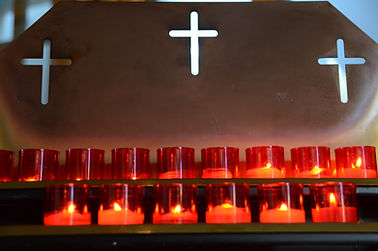
Votive candles are available at the statue of Mary and at the statue of the Sacred Heart of Jesus.
The word "votive" comes from the Latin word "votum", meaning a vow or promise. In this religious context, a votive candle is a small candle that is lit as a sign of a prayer intention, offering, or devotion; often in fulfilment of a vow or as a symbolic request for divine assistance.
08
The Nave
The Nave refers to the main interior space of a church where the congregation is seated. The Organ and Choir Area are situated on the left side of the Nave.
One of the earliest and most enduring symbolic motifs for the church is that of a boat. This imagery draws upon several key moments in the life of Christ: He preached from a boat, calmed the storm while in a boat, and walked upon the water to reach a boat. Appropriately, the term nave is derived from the Latin word "navis", meaning “ship”, reflecting the Church’s role as a vessel carrying the faithful through the spiritual journey.


09
Reconciliation Room
This Reconciliation Room provides a private setting for the Sacrament of Reconciliation. It offers confidentiality and a quiet atmosphere for individuals seeking to confess and receive absolution.
10
Glassed Porches
Glassed porches exist on both sides of the Nave. These enclosed spaces are available for parents or guardians with infants and young children who may need a quieter space during Mass. The space allows parents to remain engaged even when tending to children, reinforcing their full participation in the liturgical life of the parish.
The Glassed Porches offer a clear view of the Altar, full audio of the service, and a comfortable space. All are welcome to return to the main seating area at any time.


11
The Evangelarium
The Evangelarium resides to the left of the Altar. This ornate book contains the Gospel readings proclaimed during Mass. It holds a place of honour in the liturgy, symbolizing the presence of Christ, who is the Living Word.
As Catholics we feel the presence of God everywhere, but predominantly in Word and in Sacrament.
12
The Mortuary Space
The Mortuary Space, to the right of the Altar, is fronted by two large iron gates. This small reserved area is where funeral coffins may be placed overnight in advance of a funeral service.
The decoration of the Baptismal Font is repeated here to remind us that our Baptism is completed in death.
.jpg)

13
The Suspended Crucifix
Directly above the steps leading to the Altar, hangs a large steel Crucifix, suspended from the ceiling.
Rather than depicting the traditional image of the suffering Christ crucified, this crucifix presents a powerful representation of the Risen Christ, a figure of strength and triumph, symbolizing His victory over sin and death.
14
The Sanctuary
The Sanctuary is the most sacred area of the church and contains three central elements: the Presider’s Chair, the Lectern (or Ambo), and the Altar.
Each is carved from Portuguese limestone, emphasizing their unity and sacred purpose.
From the Presider’s Chair, the priest leads the liturgical assembly: welcoming the faithful into prayer and, at the conclusion of the liturgy, sending them forth to share God’s love in the world.
The Lectern, also called the Ambo, is the place from which the Sacred Scriptures are proclaimed. It is here that the Word of God is read, and the priest offers a homily to help the faithful reflect on the readings.
At the heart of the Sanctuary is the Altar, where the Eucharist is celebrated. In the consecration of the bread and wine, we believe they are changed by the power of God into the Body and Blood of Christ, in accordance with the words of Jesus:
"This is my Body... this is my Blood... Do this in memory of me."
Engraved around the Altar are words in Latin recalling the encounter between Jesus and two disciples on the road to Emmaus:
“…and they recognized Him in the breaking of the bread.”
This moment, recorded in the Gospel of Luke, affirms the Catholic belief in the real presence of Christ in the Eucharist.
.jpg)

15
The Paschal Candle
The Paschal Candle (from the Hebrew word Pesach, meaning Passover) is a large, white candle that symbolizes Christ as the Light of the World, risen from the dead, overcoming sin and death.
The Paschal Candle is first lit at the Easter Vigil, the night before Easter Sunday, symbolizing the light of the Risen Christ dispelling the darkness of sin and death. The candle remains lit and visible near the altar from the Easter Vigil to Pentecost Sunday.
At each baptism, a smaller candle is lit from the Paschal Candle and given to the newly baptized (or their sponsor), symbolizing the person receiving the light of Christ.
At funerals, the candle is placed near the casket to signify the deceased’s union with Christ in His death and resurrection.
The Paschal Candle is usually inscribed with several important symbols:
-
A cross, representing Christ’s sacrifice.
-
The Greek letters Alpha (Α) and Omega (Ω), meaning Christ is the beginning and the end (Revelation 22:13).
-
The current year, showing that Christ is present in every time.
-
Five grains of incense, inserted into the candle in the shape of a cross, representing the five wounds of Christ.
The Paschal Candle powerfully expresses the core of the Paschal Mystery: Christ’s passion, death, and resurrection. It reminds us of the victory of light over darkness, life over death, and hope over despair.
16
The Tabernacle and the Sanctuary Lamp
The Tabernacle is located in the Sanctuary, behind the Altar. It is a sacred and revered space because it contains consecrated hosts — communion bread that, through the celebration of the Mass, has become the Body of Christ. The Tabernacle is made of solid, opaque materials, and it is locked to ensure reverence and prevent desecration.
The presence of Christ in the Tabernacle reminds us that God still dwells among us in a real and powerful way in the Blessed Sacrament.
Near the Tabernacle burns a red light known as the Sanctuary Lamp. This lamp is always lit when the Eucharist is present, signifying the Real Presence of Jesus. It is a silent call to prayer and reverence. The lamp is extinguished only on Good Friday, the day we commemorate Christ’s death.
In the presence of the Tabernacle, Catholics genuflect (kneel briefly on one knee) as a sign of worship and reverence for the presence of Christ.
The word “Tabernacle” comes from the Latin "tabernaculum", meaning “tent.” In the Old Testament, the Tabernacle was a portable sanctuary used by the Israelites as they journeyed through the desert under the leadership of Moses. It was the place where God dwelled among His people. Once the Israelites settled in the Promised Land, this temporary dwelling was replaced by the more permanent Temple in Jerusalem.
The Special Gift of the Eucharist was instituted by Jesus at the Last Supper, where He established the New Covenant. This was the final Passover meal He shared with His disciples. The Gospels of Matthew, Mark, and Luke clearly recount this moment, and the Gospel of John affirms that Jesus went immediately afterward to the Garden of Gethsemane.
There, in Gethsemane, He began His journey of suffering and death — the Passion — through which He would offer Himself completely for our salvation.


17
Stations of the Cross
In Our Church, the 14 traditional Stations of the Cross are displayed around the interior perimeter. These stations invite us to follow Christ’s path to Calvary in a spirit of prayer and reflection. We also include a 15th Station, commemorating the Resurrection, reminding us that Christ’s suffering leads to hope and new life.
_JPG.jpg)